


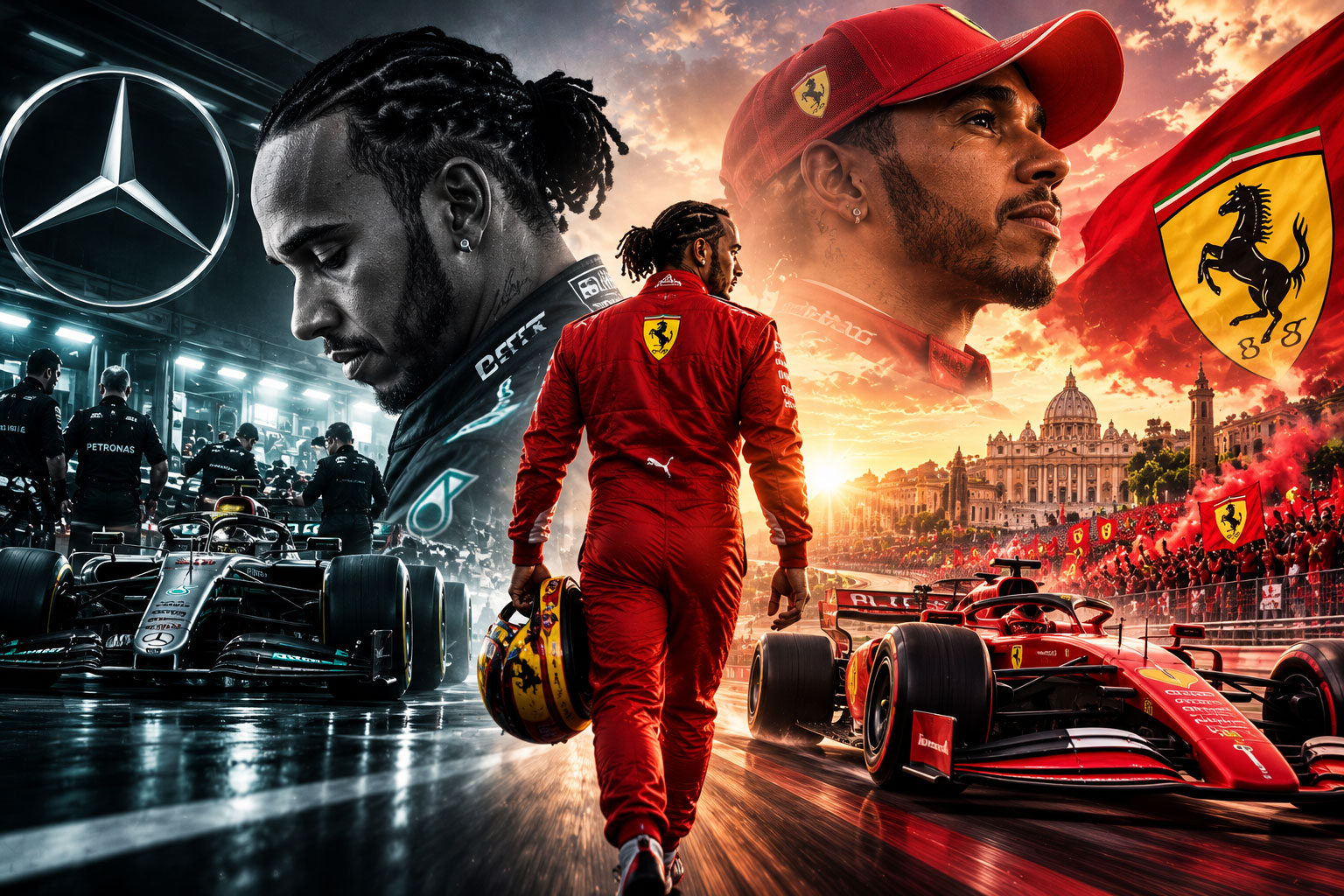
Lewis Hamilton left Mercedes for Ferrari in 2025 chasing history, an eighth world championship, the record that would separate him from every driver who ever lived. The seat he vacated went to an 18 year old Italian who had never started a Formula One race. The paddock watched with polite scepticism. Some called it a gamble.
Six races into 2026, the conversation is over.
Andrea Kimi Antonelli has won five consecutive Grands Prix, all from pole position.
He leads the Drivers’ Championship by 66 points over Hamilton, the man whose seat he took, who is now chasing him from a Ferrari. On Sunday in Monaco he became the youngest winner in the race’s history, breaking a 16 year record set by Lewis Hamilton himself.
Hamilton finished second. He watched the teenager he replaced cross the line first, then told him: “You’re catching me up.”
That is the story of the 2026 Formula One season in one exchange.
Why Now
Dominance like this rarely arrives without explanation. Antonelli is not simply talented, F1 has always had talented drivers. What makes 2026 different is that the sport changed its rules in ways that rewarded exactly what he is.
The 2026 regulations introduced the biggest technical overhaul in Formula One history.
The cars are smaller, lighter, and fundamentally different to drive.
The power unit now splits output roughly equally between a combustion engine and an electric motor, demanding that drivers manage energy deployment as a strategic weapon throughout every lap. The aerodynamics have been rebuilt from scratch — active wings that shift between high downforce and low drag configurations on demand, replacing the simple system that had been in place since 2011.
The critical consequence: the new cars reward instinct over memory. Veterans who spent years mastering the previous generation found themselves relearning from scratch. Bad habits accumulated over careers became liabilities overnight.
A 19 year old with no habits to unlearn, and eight years of Mercedes junior programme conditioning behind him, walked into the new era without the weight of the old one.
His driving style fits the new machinery as if built for it. His data shows inputs that are rounder and more continuous than his peers — aggressive but never jagged. Where the 2026 cars demand sharp initial energy to bring tyres up to temperature, he delivers. Where they demand smooth throttle management to preserve battery charge through a lap, he delivers that too. He is not choosing between aggression and efficiency. He is doing both simultaneously.
His teammate George Russell, a proven race winner and the man many expected to lead Mercedes in 2026, has admitted he is “a bit bamboozled” by Antonelli’s pace. He has also conceded the championship is now the teenager’s “to lose.”
A veteran driver, at the peak of his career, surrendering to a 19 year old before the summer break. Russell now sits third in the championship, 68 points behind his teammate.
The Hamilton Dimension
There is a particular quality to watching Lewis Hamilton finish second to Kimi Antonelli.
Hamilton is 41 years old. He is a seven time world champion, the most decorated driver in the history of the sport with 105 race wins. He left Mercedes — the team he rebuilt from the inside, the team he won six of his seven championships specifically to pursue an eighth title at Ferrari before his career ends. It was the most scrutinised decision in F1 in a generation.
He is currently being outscored by the teenager sitting in his old seat.
In Monaco, Hamilton was 23 years old when he set the youngest winner record in 2008, the year he won his first championship. Antonelli broke it at 19 years and nine months. Hamilton was on the podium to see it happen, in second place, watching a record he had held for 16 years erased by the boy Mercedes chose over him.
Hamilton said after the race: “He’s only 19, so just imagine what the future holds for him. But I’m going to do my best to try and chase him down for the rest of the year. It’s a real privilege to witness it.”
That is not the statement of a man who has found what he left for. Not yet.
What This Means
Formula One has always operated on the assumption that young drivers need time. You served your apprenticeship at a midfield team. You proved yourself over seasons, not races. You earned the top seat when you had demonstrated the maturity to handle the pressure, the machinery, and the politics of a championship campaign.
Antonelli has dismantled that assumption in six races.
He was fast tracked through the junior categories, skipping Formula 3 entirely. He had never won a major single seater championship. Toto Wolff described him as a “Verstappen like project” a generational talent to be developed, not yet a finished product. The paddock was not convinced the project was ready.
His 2025 rookie season was solid rather than spectacular — no wins, flashes of brilliance, a learning campaign that confirmed potential without yet fulfilling it.
The off season, by his own account, involved doubt. He spent months on the simulator turning uncertainty into certainty. The certainty arrived in March 2026 and has not left.
Every team in Formula One is now drawing the same conclusion: the apprenticeship model is a convention, not a law. If the right driver meets the right car at the right moment in a regulatory reset, the traditional timeline collapses. The sport’s talent pipeline just changed shape.
The Record That Says Everything
At the Japanese Grand Prix in March, Antonelli became the youngest championship leader in Formula One history, taking that record from Lewis Hamilton, who had held it since his rookie season in 2007. He was denied champagne on the podium because Japan’s legal drinking age is 20 and he had not yet reached it.
He is now 66 points clear at the top of the standings. The man whose records he is breaking is the man finishing behind him every Sunday.
“You’re catching me up,” Hamilton told him after Monaco.
The privilege of witnessing it, as Hamilton himself said, is entirely real. But privilege is not the same as comfort. The boy in his seat is not just catching him. He is passing him.